Showing posts with label sunrise. Show all posts

Sunday, 11 December 2022

Dawn Shipping Photos

It is that time of year when my commute to work often coincides with sunrise or other early morning lighting, and I managed to make a few nice images as a result in October and November.

ACL's appropriately named Atlantic Sun was departing Halifax one morning while I chased photos of the USS Gerald R. Ford.

Dynamogracht entering the harbour at sunrise.


ONE Hangzhou Bay entering Halifax Harbour at sunrise.

Unfortunately, the morning I was chasing the USS Gerald R. Ford, I didn't manage to get a spectacular sunrise image - this was the angle I received the morning that Atlantic Sun was leaving. 


Atlantic Sun departing off to the right with the USS Gerald R. Ford at left.

I tried to convince my editor at Warships IFR that he should include the following photo inside the magazine, and feature wording to the following effect on the cover: "USS Gerald R. Ford off the rails! Photos inside."

For some reason, he didn't go for it, but I thought it was a great idea. 

USS Gerald R. Ford "off the rails" as it were, pictured from the Dartmouth side. 

That said, a few mornings later, I did manage to get a sunrise shot from the Halifax side that I was happy with.


USS Gerald R. Ford at sunrise from Halifax.


Sunday, 13 December 2020

HMCS FREDERICTON operations

 FREDERICTON was working up at sea this week, and I was lucky enough to catch her just as she weighed anchor and headed out of Halifax Harbour on Wednesday last week. When I boarded the ferry, the engines were running as apparent from the funnel emissions. 


The next image shows the decommissioned Deep Panuke platform in the background at the Woodside pier. This platform left Halifax later in the week, destined to be broken up at Sheet Harbour.


Halfway across on the ferry, the anchor appeared above the surface, confirming that the ship was about to get underway. Unlike on Friday, no tugs showed up on Wednesday, suggesting she was headed for sea.


With the anchor hauled up, the ship starts to turn to head out. The NSCC building is in the background.


After leaving the ferry, I rushed out to the end of Cable Wharf to get some more photos, arriving just in time to capture FREDERICTON as she passed Georges Island. I was fortunate that there was still a bit of a light show left over in the sky from sunrise. 


Passing the lighthouse on Georges Island.


FREDERICTON returned to Halifax in July after a 6-month NATO deployment during which her Cyclone helicopter crashed and 6 members of her complement were killed. In recent weeks, she has started operating a Cyclone again.

Saturday, 23 May 2020

Sunrise at Lawrencetown Beach

I'm not one for early mornings, but after two months of social distancing and staying within a few blocks of home, I took advantage of the reopening of provincial beaches and headed out to Lawrencetown for sunrise. With sunrise scheduled around 5:30am, I got up before 5 and jumped immediately into the car. Despite the early hour, there were already hikers on the nearby Salt Marsh Trail. When I arrived at Lawrencetown Beach, the horizon was a nice shade of orange, and there was a nice array of clouds in the sky to turn the sky pink. 


In the distance along the beach and out past the headland, there was a nice low-lying fog to give atmosphere to my images. 


I stayed on the beach for at least an hour, and even long after the sun had cleared the horizon, there were still photographic opportunities. 


Getting the camera down low provides an interesting perspective to landscapes, especially when there are shiny beach stones with which to populate the foreground. 
Once I tired of the landscapes, there were plenty of detail images available, and I'm always a sucker for sea foam and long exposures of flowing water.


I would forgive the viewer for thinking I had placed this piece of seaweed in order to create this image, but it was as I found it - and soon after I took this image, a wave ventured higher up the beach than most and rearranged it into something less picturesque.

A retreating wave flows around a rock.

On my way out to the beach, I had passed a number of coves and islands, where the sea was still utterly due to the absence of wind. Hoping that the water's mirror surface remained, I started my return to the city. I was in luck!

With only a group of ducks swimming by to disturb the water, this tree along the Salt Marsh Trail reflects on the water's mirror surface.

In comparison to the following image, this little island allowed me to isolate the trees within the frame of the image.


For some reason, I really like the mixture of dark & light greens and reds with the blue of the sky and the white of the wind-fallen trees. If you look carefully, you can see the heron that I missed until I zoomed in on the image - though it isn't where you might expect to find it.
Even here, I found some detail shots to keep me there a few minutes longer.

Close to shore, the remains of the previous season's reeds lie just under the water's surface as the current crop start to poke up and cast their own reflections.
All in all, this was a much needed photographic therapy session.

Saturday, 23 March 2019

CCGS Louis S. St. Laurent

Since her relocation to St. John's in 2009, CCGS Louis S. St. Laurent is no longer a common sight in Halifax, and it has been several years since I last managed to take photos of her at all, let along underway in the harbour. Currently hard at work in the Cabot Strait and Gulf of St. Lawrence, the Louis had to pop into Halifax for fuel and possibly supplies and a crew change. Although disappointed on Monday when she headed straight to the Irving wharf to refuel, we got lucky on Tuesday as her up-harbour transit coincided with both sunrise and our ferry ride.

CCGS Louis S. St. Laurent.
Launched in 1966 and commissioned in 1969, the Louis is second in age in the Canadian Coast Guard fleet to only the CCGS Hudson. Originally built with a somewhat inefficient turbo-electric (steam) powerplant driving three shafts, intended to provided necessary experience to CCG crews in the event that Canada subsequently procured a nuclear-powered icebreaker, Louis received an extensive refit in Halifax between 1988 and 1993 that converted her to diesel-electric propulsion and provided her with a new, lengthened, bow with an air bubbler system.

This makes 2019 her 50th anniversary of beginning service in the CCG fleet.

CCGS Louis S. St. Laurent.

CCGS Louis S. St. Laurent.

CCGS Louis S. St. Laurent.
Louis was showing off with her starboard bubblers (the port ones didn't seem to be active) during her transit (either that or the bow thrusters which I believe she also has). I'd like to think it was solely for my benefit to make for more impressive photos, but they were probably just exercising the system. The bubbler system is used during ice breaking operations to reduce the friction between the hull and the ice being broken.

CCGS Louis S. St. Laurent.

CCGS Louis S. St. Laurent.

CCGS Louis S. St. Laurent meets the future HMC Ships Harry Dewolf and Margaret Brooke for what I believe may be the first time.

CCGS Louis S. St. Laurent.

CCGS Louis S. St. Laurent.
Classed as an "Arctic Class 4" or "Heavy Gulf" icebreaker, the Louis S. St. Laurent is currently Canada's largest and heaviest icebreaker (the smaller CCGS Terry Fox, also an "Arctic Class 4" vessel, was taken up in the 1990s from commercial service). She is due to be replaced by the "Polar Class 2" icebreaker CCGS John G. Diefenbaker sometime in the 2020s. Only time will tell if the Louis reaches 60 years of service before being replaced or otherwise taken out of service due to her age and condition.

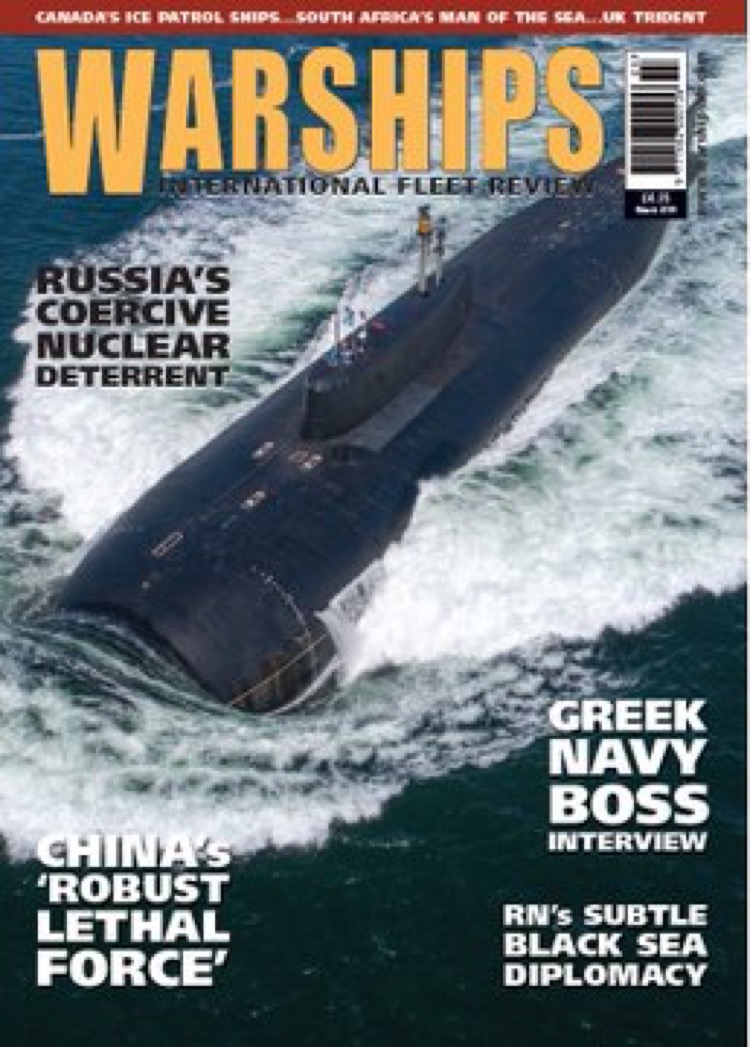
Meanwhile, the Royal Canadian Navy is getting back into the Arctic business. Seen in some of the photos above are the first two Arctic Offshore Patrol Vessels (AOPV), the future HMC Ships Harry Dewolf and Margaret Brooke. These "Polar Class 5" vessels carry a much lighter polar rating than the CCG ships, and will likely be limited to summer service in the Arctic. They will also carry out offshore patrols in the Atlantic and Pacific oceans. For more background on these ships, check out the March edition of Warships IFR magazine, for my article starting on Page 37 (probably available at Atlantic News or Chapters sometime in early April). The cover appears below.


Monday, 4 September 2017

Overnighting in Fortress Louisbourg

I'm still editing away at the Tall Ships 2017 images, so I thought I would post this first.

I recently had the opportunity to spend the night within the walls of Fortress Louisbourg, an option that Parks Canada only began offering within the last few years. We chose to stay in Lartigue House, but there were also four tents available within the courtyard of the King's Bastion. 

Lartigue House at dusk. These tents were left over from a previous function, and we didn't sleep in them.
Fortress Louisbourg typically closes at 5 PM daily, and staff usually leave by 5:30, so I personally have never had an opportunity to photograph the fort outside of normal hours. By spending the night, I was able to experience sunset, nighttime, and sunrise - and got to photograph all three.

Sunset viewed from the wall of the King's Bastion. The four tents available to campers can be seen in the background.
Most of the fortress's buildings are locked up after hours, but otherwise we had the run of the fortress, and I went where I pleased. The only real warning we received from staff was to not climb the walls outside of the normal walking paths, because of the 30 foot drop beyond. 

Sunset behind one of the cannon.
At this point mosquitoes made their presence known, and I had to edit quite a few black spots from these images, which I assume were insects because they thankfully don't appear in any of my images the following morning. 


Sunset behind the cannon of the King's Bastion. The nearer cannon was "fired" during demonstrations during the day.
Even once the sun had set, there were opportunities to photograph the fortress at dusk.


Wide-angle image of the fortress at dusk, with the seawall at left, Lartigue House in the centre, and the walls of the King's Bastion to the right.
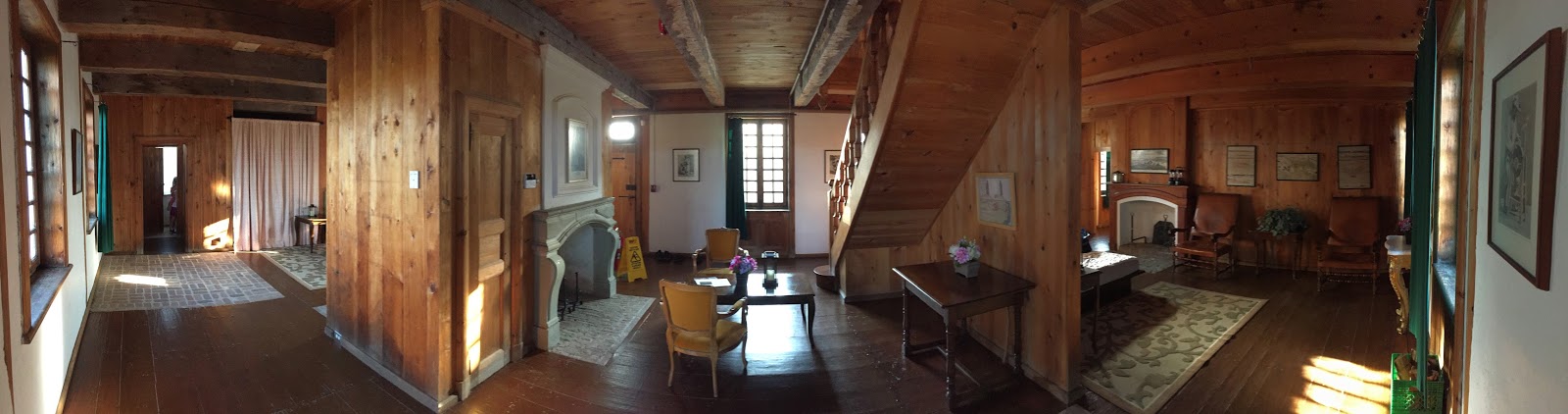
After getting my fill of shooting at dusk, I retreated inside to avoid the mosquitoes for a while, and had dinner. The interior of Lartigue House is fairly spartan, from modern standards: we had two double beds upon which to sleep, some chairs, a washroom (without a shower, though we were told one will be added for next year), and a small kitchenette with a sink, small fridge, and microwave. The house had the added benefit of not being located right next to the clock tower, which sounded a bell every 15 minutes - we could hear it, but it didn't wake us up during the night. We were also provided with a Coleman stove for use outside if we wanted to do some cooking, and wood could be purchased for the fireplace outside.

Panorama of the interior, from the central room. The bathroom is to the far left, kitchen to the right (door hidden), and the sitting room in the centre. The two bedrooms are to the left and right of the sitting room. The upstairs of the house is used for storage, and is not accessible to visitors. 
Later that evening, I went back out with my camera for some more shooting. The mosquitoes had mercifully decided to pack it in for the night, and I wasn't bothered by them again.

The yard of Lartigue House. I lit the two tents with a single LED flashlight each, though I may have also painted the tent to the right with a third flashlight. The fortress was partially lit that night by the waxing gibbous moon visible in this shot.

The four tents in the courtyard of the King's Bastion. Only three were occupied that night - one party didn't show up - and the family in the tent to the left went to bed early. The brightly lit room to the left is the washroom available to campers.
Tent campers were provided with a tent for up to four people, a fireplace, and a Coleman stove among other things. All guests, in either tents or the house, needed to bring their own sleeping bags.

Another view of the King's Bastion building and courtyard. The yellow glow in the background is from the modern town of Louisbourg. I was lucky to have the Big Dipper well placed above and to the left of the clock tower. The waxing gibbous moon was not very bright, and this image took 30 seconds at ISO 640 and f/2.8 with my Zeiss Touit 12mm (18mm on an APS-C sensor) lens. I was fortunate the the moon wasn't bright enough to wash out the stars.

The moonlight was just enough for this image taken through the tunnel running through the King's Bastion building under the clock tower. Two cannon can be seen on the wall in the background.

This image is looking in the opposite direction, towards the town, and I used a flashlight to paint the clock tower. 

I took this while on my way back to the Lartigue House for the night. This shot looks down one of the streets to the main gate in the sea wall, and the Big Dipper makes a partial appearance in the top left.
Walking the empty streets of Louisbourg at night is an experience I won't soon forget.

I'm not a big fan of getting up early in the morning, but I felt compelled to try my luck the next day with the sunrise - and it was well worth it! After spending a few minutes scouting locations, I finally realized that one of the apps on my phone would provide me with the precise location of the rising sun, and I discovered that one of the streets in the town was perfectly aligned with the spot on the horizon where the sun made its appearance.

The sun rises between the buildings to the left of the image. I may have <cough> deleted <cough> an offending Parks Canada vehicle that appeared at the end of the street.

I really couldn't believe my luck with how well the sunrise lined up with this street.

It took almost every millimeter of my 12mm lens to fit in the entire King's Bastion building and still have room for the cannon and the rising sun. 


The rising sun captured from inside the tunnel through the King's Bastion building.


Once again, I needed my 12mm wide angle lens to capture the light of the rising sun washing over the King's Bastion building - and I ended up capturing my own shadow to boot. Oops. 

Another angle on the King's Bastion building. I had to erase one of the camper's vehicles from the left of the image.


Most of the yards within the town are fenced, and a number have farm animals in them.
I have not yet gone through my daylight images of the fortress, and I imagine they will result in a separate blog post once I have some time to edit them.