Saturday, 27 April 2019

Return from Operation Projection

By heading down for lunch on board HMCS SACKVILLE in HMC Dockyard, I was just in time to catch the return of Maritime Coastal Defence Vessels (MCDV) KINGSTON (MM 700) and SHAWINIGAN (MM 704). Both ships participated in a 5-month long cruise to Western Africa as part of Operation Projection. 

KINGSTON was already alongside when I arrived, and the crew were seeing their families for the first time in months.
Also alongside, and their crews manning the rails (of the outside ships at least), were VILLE DE QUEBEC (background), GOOSE BAY (left and aft of KINGSTON), and GLACE BAY (right and aft of KINGSTON).


SHAWINIGAN making her first appearance from my position.

Tugs alongside, SHAWINIGAN enters the camber.

The crew of GOOSE BAY doffing their caps to the arriving SHAWINIGAN.

Tugs easing SHAWINIGAN alongside KINGSTON.

Though small and under-armed (currently with only a pair of .50 calibre machine guns on the bridge wings), these ships still manage to provide useful service, and seem to be ideal for coastal missions showing the flag such as Operation Project along the coast of Western Africa.

Formerly armed with 40mm Bofors guns on mountings that could trace their direct lineage to the Second World War (the legendary "Boffin"), these ships were designed and built to be manned by the Naval Reserve and provide a notional mine warfare capability (or, at least, mine warfare training) along with other utility functions. While the 40mm gun has been removed from all the ships, and a remote weapons system trialed on GOOSE BAY not adopted for permanent installation, these ships have been deploying fairly widely in recent years, with the African coastal trips probably the most ambitious.


Saturday, 20 April 2019

HMCS Ville de Quebec

HMCS VILLE DE QUEBEC spend Tuesday night at anchor in Halifax Harbour, before heading out again on Wednesday morning. These photos start with the anchor hoisted, and the crew washing mud from the harbour bottom off the anchor and chain.


The black line running down the hull ahead of the bridge is the wash water from cleaning the anchor and chain.


The mats hanging at various locations from the rail and above the bridge are radar absorbent material placed in front of fittings that produce large radar returns - they are intended to reduce the overall Radar Cross Section (RCS) of the ship.

Sunday, 14 April 2019

Canadian Ice-breaking

I was having a short discussion on Twitter this week, and discovered that my admittedly limited knowledge of ice-breaking is apparently as obsolete as the Canadian Coast Guard's ice-breaking fleet is.

As noted in a previous post, CCGS Louis S. St. Laurent, the CCG's largest and arguably most capable icebreaker, was commissioned 50 years ago this year. Although she received an extensive refit that saw her outfitted with new engines and a longer bow with a bubbler system, she is reaching the end of her lifetime. 

CCGS Louis S. St. Laurent showing off her bubbler system.
The CCG's only other "Heavy Gulf" class icebreaker, the Terry Fox, is a ship taken up from commercial trade. She also has a bubbler system. Bubbler systems are designed to reduce the friction between the bow of the ship and the ice, allowing the ship to ride up higher on the ice to break it with the weight of the ship. Although newer than the Louis, the Terry Fox is far from young, as she dates from the 1980s.


Terry Fox, similarly showing off her bubbler system.
The CCG's heavy icebreakers are supplemented by a group of "Medium Gulf" icebreakers, the Type 1200 or Pierre Radisson class. With Pierre Radisson herself built in 1978, she is older than Terry Fox.


Pierre Radisson underway in Halifax Harbour.


Amundsen underway in Halifax Harbour

Henry Larsen departing Halifax Harbour

Henry Larsen arriving in Halifax at sunrise.
The dedicated icebreaker fleet is supplemented by a fleet of light ice-breaking aids-to-navigation tenders. I believe these ships are fairly conventional as icebreakers go.

CCGS Edward Cornwallis is one of a class of Type 1100 light icebreaker / major navaids tenders.

Earl Grey is one of two Type 1050 medium navaids tenders / light icebreakers.
All of these ships have a conventional arrangement of shafted propellers, and are intended to break ice with their bows in a forward direction.

The state-of-the-art in ice-breaking has changed, though. Newer designs incorporate azimuth thrusters, and many are designed to break ice with their sterns, and moving backwards through the ice. Even the fancy bubbler systems in "newer" Canadian Coast Guard icebreakers are now at least partially obsolete, replaced by modern paint coatings and the lubricating effect of the azimuth thrusters.

In response to some posts on Twitter between myself and Dr. Samuel McLean, Aker Arctic (their website features a video of one of their designs breaking ice in an aft-sideways direction) was kind enough to chime in with some expert information. The Twitter thread follows.


The shape of the icebreaker pictured above can be seen here, although good luck reading the text (you might have to get your browser to translate for you).


So there you have it - apparent even from this short thread, ice-breaking technology has moved on considerably.

The CCG's future heavy icebreaker, the John G. Diefenbaker, will be fitted with two conventional wing shafts with a single azimuth thruster in the middle - from the look of her, she is designed to break ice with her bow, and she will also be fitted with a bubbler system as well as two bow thrusters. Interestingly, Aker Arctic is a member of the design team. 

Although initially intended to incorporate azimuth thrusters for breaking ice going astern, the Navy's new HARRY DEWOLF class of Arctic/Offshore Patrol Vessels (AOPVs) are being built with conventional shafted propellers (with a bow thruster) to allow ice-breaking by the bow. I have no information to suggest whether they have been built with a bubbler system, but perhaps the bow thruster can help with that.


Future HMC Ships HARRY DEWOLF and MARGARET BROOKE under construction last weekend at the Halifax Shipyard.

Close-up of HARRY DEWOLF's conventional icebreaking bow and bow thruster.

HARRY DEWOLF's conventional twin shafted-propeller arrangement (propellers not fitted in this photo) and her twin rudders.


Sunday, 7 April 2019

US Navy visitor

Thanks to receiving forewarning on Twitter on Saturday, I knew that USS JASON DUNHAM was to arrive on Sunday, and was able to make it down to the Dartmouth waterfront in time to take photos of her approaching the jetty.


USS JASON DUNHAM rounding George's Island.

I had to crop this one to get rid of the tug.

By this time, we had resigned ourselves to the fact that the tugs weren't going to cooperate and were going to be in the way of most of our images.


Due to the position of the sun, and the presence of the tugs, we never did get a good clear view of the ship without shadows or tugs. 

USS JASON DUNHAM.s battle ensign streaming out in a stiff wind.

The ship turned in front of Purdy's Wharf so that the tugs could push her into Jetty NB port side to.


JASON DUNHAM (DDG 109) is a member of the Arleigh Burke class of guided-missile destroyers - specifically, she is one of the Flight IIA ships of this class, and built to a modified design with a helicopter hangar - something the first flights of the class were missing. Taken in their entirety, the Burke class are the most numerous warship in the US Navy.


Saturday, 23 March 2019

CCGS Louis S. St. Laurent

Since her relocation to St. John's in 2009, CCGS Louis S. St. Laurent is no longer a common sight in Halifax, and it has been several years since I last managed to take photos of her at all, let along underway in the harbour. Currently hard at work in the Cabot Strait and Gulf of St. Lawrence, the Louis had to pop into Halifax for fuel and possibly supplies and a crew change. Although disappointed on Monday when she headed straight to the Irving wharf to refuel, we got lucky on Tuesday as her up-harbour transit coincided with both sunrise and our ferry ride.

CCGS Louis S. St. Laurent.
Launched in 1966 and commissioned in 1969, the Louis is second in age in the Canadian Coast Guard fleet to only the CCGS Hudson. Originally built with a somewhat inefficient turbo-electric (steam) powerplant driving three shafts, intended to provided necessary experience to CCG crews in the event that Canada subsequently procured a nuclear-powered icebreaker, Louis received an extensive refit in Halifax between 1988 and 1993 that converted her to diesel-electric propulsion and provided her with a new, lengthened, bow with an air bubbler system.

This makes 2019 her 50th anniversary of beginning service in the CCG fleet.

CCGS Louis S. St. Laurent.

CCGS Louis S. St. Laurent.

CCGS Louis S. St. Laurent.
Louis was showing off with her starboard bubblers (the port ones didn't seem to be active) during her transit (either that or the bow thrusters which I believe she also has). I'd like to think it was solely for my benefit to make for more impressive photos, but they were probably just exercising the system. The bubbler system is used during ice breaking operations to reduce the friction between the hull and the ice being broken.

CCGS Louis S. St. Laurent.

CCGS Louis S. St. Laurent.

CCGS Louis S. St. Laurent meets the future HMC Ships Harry Dewolf and Margaret Brooke for what I believe may be the first time.

CCGS Louis S. St. Laurent.

CCGS Louis S. St. Laurent.
Classed as an "Arctic Class 4" or "Heavy Gulf" icebreaker, the Louis S. St. Laurent is currently Canada's largest and heaviest icebreaker (the smaller CCGS Terry Fox, also an "Arctic Class 4" vessel, was taken up in the 1990s from commercial service). She is due to be replaced by the "Polar Class 2" icebreaker CCGS John G. Diefenbaker sometime in the 2020s. Only time will tell if the Louis reaches 60 years of service before being replaced or otherwise taken out of service due to her age and condition.

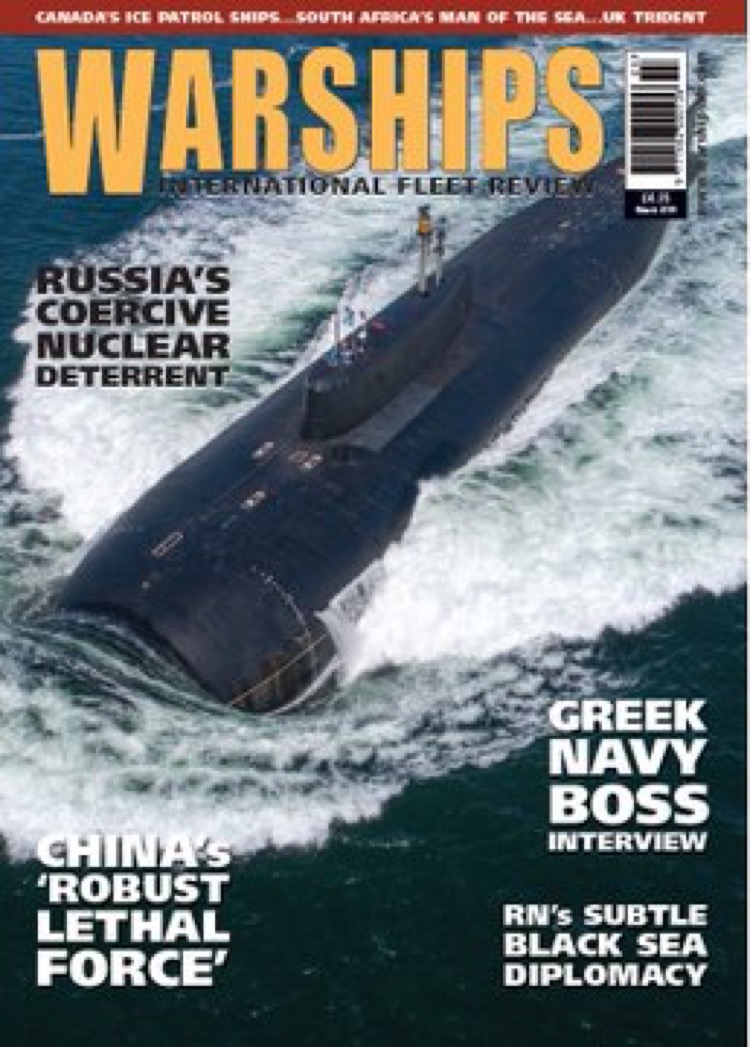
Meanwhile, the Royal Canadian Navy is getting back into the Arctic business. Seen in some of the photos above are the first two Arctic Offshore Patrol Vessels (AOPV), the future HMC Ships Harry Dewolf and Margaret Brooke. These "Polar Class 5" vessels carry a much lighter polar rating than the CCG ships, and will likely be limited to summer service in the Arctic. They will also carry out offshore patrols in the Atlantic and Pacific oceans. For more background on these ships, check out the March edition of Warships IFR magazine, for my article starting on Page 37 (probably available at Atlantic News or Chapters sometime in early April). The cover appears below.


Sunday, 17 March 2019

Coast Guard ship traffic last week

Transits of two different coast guard vessels coincided with my ferry travels this week, one USCG and the other CCG. First, on Tuesday, the veteran fisheries science vessel CCGS Alfred Needler:


CCGS Alfred Needler.
Built in Pictou at Ferguson Industries Limited in 1982, Alfred Needler is showing her age and is probably due for replacement.

CCGS Alfred Needler.


CCGS Alfred Needler.

Photography of early morning ship traffic like this, before sunrise, usually benefits from nice colours in the sky (when it isn't overcast, of course).

Friday saw the arrival of the USCGC Seneca (WMEC 906), a Bear or Famous class medium endurance cutter. Laid down in 1982 and commissioned in 1984, Seneca isn't young either. The entire class of ships has apparently benefited from inherited equipment from retired USN Perry class frigates, to extend their lives into the 2030s. After 35 years of service in the USCG, though, Seneca looks to be in fairly good shape externally, and well taken care of. She went alongside in HMC Dockyard, and will probably stay until at least Monday morning. 

The US and Canadian Coast Guards differ in mission and manning - while the CCG is a civilian organization tasked with missions such as search and rescue, maintenance of aids to navigation, and icebreaking, the USCG is an armed service which does these missions as well as patrol the territorial waters of the United States. 

USCGC Seneca.

USCGC Seneca.

USCGC Seneca.

USCGC Seneca.

USCGC Seneca.

USCGC Seneca.
The first member of this class, USCGC Bear, is named after an earlier Bear - USRC Bear (AG-29).  The earlier Bear (retold here by Andrew Toppan) lived an exciting life, and eventually sank off Nova Scotia in the tow of Irving Birch while on her way to Philadelphia. 

For no better reason than that I haven't shown them here yet, the CCG lifeboat Courtenay Bay also made an appearance, but back in early February. Based in Saint John, Courtenay Bay is a member of the British-designed Arun class of search and rescue boats. 


Built in 1994, these boats are gradually being replaced with the newer, larger, and more capable lifeboats designed by Robert Allen Limited and based on the British Severn class lifeboat. 


A good comparison of the Arun-adapted Cap-aux-Meules (left) and the larger Severn-adapted Baie de Plaisance on the right, taken in the Magdalen Islands in August 2018.

It is my understanding that both of these classes are preferred over the USCG-adapted Cape-class lifeboats introduced in the early 2000s.